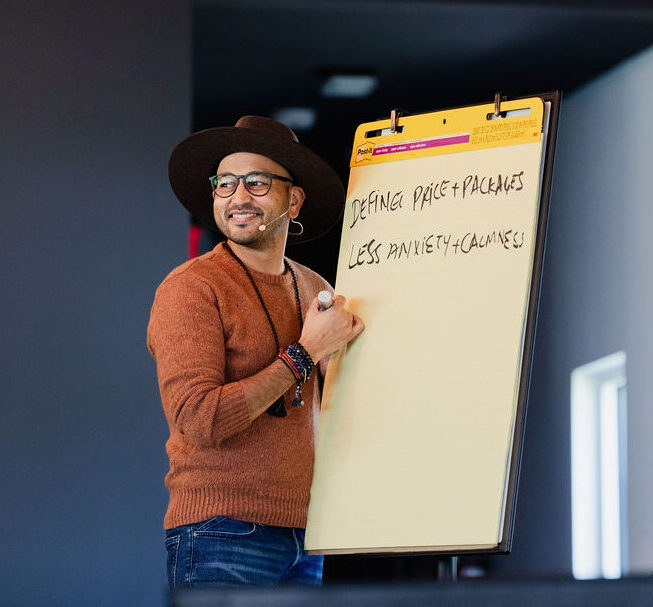

I want to give you a tool to help you plan for 2026, but before that, today is the last day to enroll in Greater Inside.
So, for a winning 2026, learn more about Greater Inside and decide today →
Every founder believes they need a “perfect plan” to start the year strong.
A clear roadmap. Detailed goals. A flawless 12-month strategy.
Here’s what actually happens:
Most founders don’t fail because they plan too little. They fail because they treat every planning decision like it’s irreversible.
That pressure creates overthinking, hesitation, and false certainty. Instead of moving forward, they get stuck trying to eliminate risk, waiting for clarity that only comes after action.
How Jeff Bezos Stopped Amazon From Imploding Every January

In the early days of Amazon, the company appeared to be moving fast. Revenue was growing, teams were expanding, and momentum was visible from the outside.
Inside the building, progress felt slower.
Teams worked hard, but even small decisions took an unusually long time.
A minor product change could stretch across weeks. One meeting turned into several, and projects that should have taken a month quietly expanded into an entire quarter.
The issue was not effort. It was fear.
People were afraid of making the wrong choice. Even small decisions felt permanent. A test launch, a timeline shift, or a minor feature change carried an invisible weight. Everyone acted as if a single misstep could undo months of work.
So teams waited. They waited for more clarity, more data, and more certainty. But while they waited, nothing moved.
By the time January arrived, the delays had piled up. Deadlines collided. Stress increased. The year felt behind before it had truly begun.

Eventually, Jeff Bezos addressed the real problem. He explained that not all decisions are created equal.
There are two types.
Type 1 decisions are big and hard to reverse. These choices are rare. When you walk through the door, there is no easy way back. These decisions deserve careful thought, debate, and patience.
Type 2 decisions are small and reversible. If the outcome is wrong, you can walk back through the door. These decisions are common, and they should be made quickly.
Then Bezos shared the rule that changed how the company operated. Most decisions should be made with about 70 percent of the information.
This idea surprised people.
They were used to waiting for full certainty. Nearly every choice had been treated like a Type 1 decision.
Planning had become an exercise in avoiding mistakes rather than creating progress.
Once that belief shifted, the company changed almost immediately. Teams began moving again. Decisions happened faster. Overthinking faded. Projects finished.
What changed was not the work itself, but the story people told themselves. When they stopped believing that every decision had to be perfect, the organization could move forward again.
The lesson is simple. Speed creates clarity. Action creates feedback. Movement creates momentum.
A perfect plan that arrives too late is useless. A good plan, acted on quickly, can change everything.
Amazon did not grow by making perfect decisions. It grew by taking the next step sooner and adjusting along the way.
Planning Paralysis Comes From Treating Small Decisions Like Big Ones
Most founders think their annual plan is a massive, permanent, high-stakes commitment.
Something that, once written, locks them in for the next twelve months.
It is not.
Your yearly strategy feels like a Type 1 decision because it spans a whole year.
But it is actually Type 2.
You can adjust it anytime as you learn, grow, and respond to the market.
Nothing breaks if you shift direction in March, June, or even October.
Your January priorities feel important because they kick off the year.
But they are completely Type 2.
- You can change them with new data.
- You can drop what no longer matters.
- You can update your focus the moment you get clearer.
Your monthly focus is the same.
It is not a rigid contract. It is a guide, not a rule.
If your business changes, your focus can change with it.
There is no penalty for adjusting.
The problem is not that you are bad at planning.
The problem is that you treat almost every decision as permanent.
You treat flexible choices like irreversible ones.
And this creates pressure, hesitation, and unnecessary delay.
Ask yourself:
- Where am I overthinking something that could be decided today?
- What am I postponing because I am waiting for full clarity?
- What would feel easier if I simply called it reversible?
When you treat more decisions as Type 2, everything becomes lighter, faster, and easier to execute.
Stop Planning for Perfection. Start Planning for Movement.
When you plan your year as if everything must be right from day one, you get stuck.
You spend weeks tweaking goals. You rewrite priorities. You hesitate to commit because it feels like you only get one shot.
Every decision carries too much weight, so nothing moves.
The problem is not a lack of planning. The problem is expecting your plan to predict the future.
Business rarely works the way you imagine it will.
The offer you think will succeed might fall flat.
The channel you treat as secondary might become your main growth engine.
A casual conversation might turn into a partnership that changes everything.
You cannot see these outcomes in advance. They only appear after you take the first imperfect step.
When you plan with the expectation that you can adjust, everything changes.
You take action sooner.
You pick a starting point instead of waiting for certainty.
You try something small and learn from real feedback, not guesses.
Progress speeds up because you are no longer planning in theory. You are planning in motion.
This is what many founders miss. Planning is not about predicting August in January. You cannot know which idea will take off or which path will close. Planning is about choosing a direction that gets better as you move.
You make a decision today. You tighten it next week. You refine it again next month. The plan improves because you are inside the work.
You do not need a perfect 12-month roadmap. You need a rhythm that keeps you moving.
You do not need to map every detail. You need clear next steps.
You do not need perfection. You need measurable progress, even if it is small.
A simple approach works better than an elaborate one.
Movement creates information. Information leads to better decisions. Better decisions create results.
Perfection only creates delay.
The 2026 Plan You’ll Actually Use
Not a resolution. Not a wish list. A roadmap.
1: Start with Your Dream Intention
Your intention is your North Star. The feeling you want to carry through every decision, every day, every month.
Reflection Questions:
- How do I want 2026 to unfold?
- Why does this matter to me?
- What part of my life is asking to be transformed?
Write it down. One clear vision. That is your anchor for the year.
2: Bring Your Attention to Progress
Focus on the few goals that will actually move the needle. Three to five goals are enough.
Reflection Questions:
- Which 3–5 goals will move me closest to my dream?
- How will I know I’m making progress daily?
- What small wins will keep me motivated?
Make it measurable. Make it yours. Make it matter.
3: Build Your Support System and Clear the Path
Your environment either fuels your vision or drains your energy. Choose wisely.
Reflection Questions:
- Who are the three people that can help me with my goals?
- Who or what do I need to let go of to make space for my dreams?
- What relationships drain my energy versus fuel my vision?
Surround yourself with believers. Distance yourself from doubters.
4: Create Your Monthly Focus
One theme per quarter keeps your progress intentional and aligned.
Reflection Questions:
- What will be my central focus each month?
- Jan–Mar: ________________________
- Apr–Jun: ________________________
- Jul–Sep: ________________________
- Oct–Dec: ________________________
One theme. One priority. Twelve months of intentional progress.
5: Design Your Success Systems
Your tools, habits, and tracking systems turn intention into action.
Reflection Questions:
- What tools or systems will help me get closer to my dreams?
- What daily habits will compound into yearly results?
- How will I track my progress without obsessing?
Systems create safety. Habits create momentum.
6: Repeat It, Not Perfectly, But Consistently
Progress comes from small weekly adjustments, not giant leaps.
Weekly Check-In:
- Am I still connected to this intention and these goals?
- What did I do well this week?
- What can I do better next week?
Small adjustments. Weekly recalibration. That is how dreams become reality.
This is not about changing your life in one year.
It’s about becoming the person your dreams are waiting for.
Intention. Attention. Repetition.
That is the plan.
And this time, it will actually work.
Your Action Steps + a Gift for you
I created a custom GPT to make your 2026 planning process easier and more effective.
Instead of guessing what to focus on or overthinking your goals, this tool guides you step by step, helping you clarify your intention, define meaningful goals, design supportive systems, and stay aligned all year.
Get the custom 2026 GPT planner here
How to use it:
- Simply enter a short message (for example, “Hi”) to get started.
- You’ll be guided through 8 questions. Answer each one with as much detail as you can.
- Based on your answers, the GPT will create a clear 12-month plan, a 90-day focus, and a 6-week sprint you can follow step by step.
Let’s build it together
I’m working closely with 20 founders to help them achieve all their goals in 2026 without overwhelm. Most spots are already taken, and only a few remain.
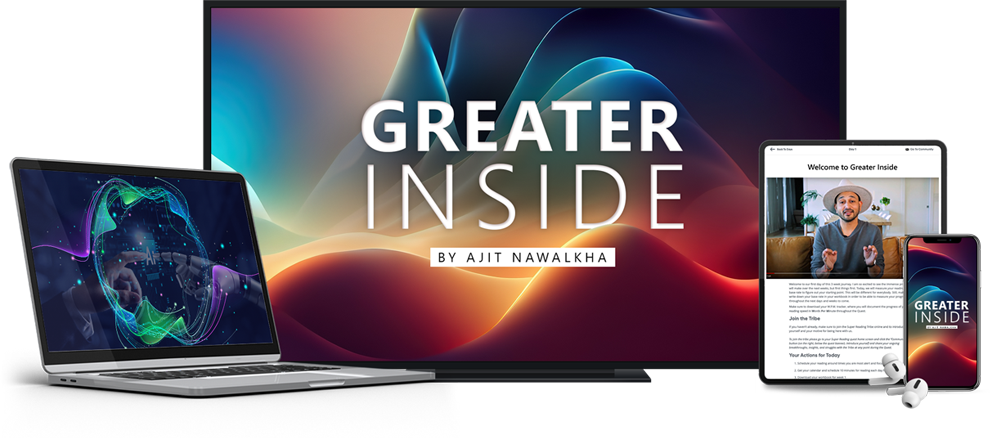
This program is for brilliant, chaotic minds who want structure to build their dream.
You’ll get advanced tools, systems, and coaching to grow your business to $500k in the next 12 months, win back your time and energy without sacrificing meaning or family life, and build mental, emotional, and physical systems to scale yourself as effectively as your business.
You’ll also stay aligned with your vision so growth feels fulfilling and sustainable.
If the spots fill up by the time you see this, you can join the waitlist to be notified as soon as one opens.
How Did We Do?
If this gave you a perspective you haven’t heard before, share your thoughts in the comments below. I read every comment — your feedback helps me create content that truly moves you forward.
Love. Ajit