Thinking is not the same as doing. But it feels exactly like it. That is the problem.
Six months of refining the offer.
Perfecting the messaging.
Waiting for the right moment.
And still, no clients.
Thinking too much is a trap that feels productive.
But at the end of six months, if you still have zero clients and a very refined set of opinions about your niche, and you still don’t feel ready to start..
It’s about time you took action.
How Jeff Bezos killed the “perfect plan”
In 1994, Jeff Bezos was working at a hedge fund in New York. Good job, good money, good future.
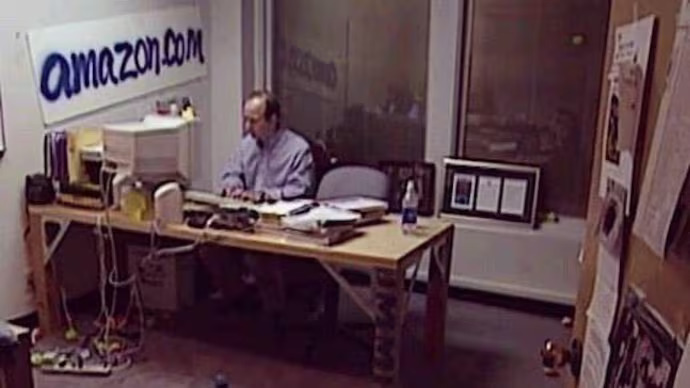
He read a statistic that web usage was growing at 2,300% per year.
He did not spend six months building a business plan.
He did not wait for certainty.
He quit, drove across the country with his wife, and started writing the business plan in the passenger seat on the way to Seattle.
He called it the regret minimisation framework.
He asked himself one question: when I am 80, will I regret not having tried this?
The answer was yes. So he went.
Amazon did not win because Bezos had a perfect strategy.
He actually had a very simple one. Sell books online. Start there. See what happens.
What he had was a deadline he set for himself. So he put his decision in motion before he had all the answers.
Most of us are waiting for the answers before we move. Bezos moved and found the answers on the road.
The difference between a plan and a sprint
Here is what I have found after building several companies and now watching founders inside Greater Inside do this in real time.
A plan gives you comfort. A sprint gives you data.
And data is the only thing that actually tells you if your offer works, if your market is real, if your pricing makes sense.
You cannot get data by thinking. You can only get data by doing.
A six-week sprint is a solid, tested system.
It compresses a year of gradual drift into 42 days of focused movement.
And in those 42 days, you will learn more about your business than you would in six months of planning.
The reason it works is simple.
Six weeks is short enough that you cannot hide from it. A year feels distant, so your brain allows procrastination.
Six weeks feels immediate. Every week counts. Every conversation matters.
Why most service founders stay stuck before they even begin
There are three places I see people lose momentum before they even launch. And it is almost always one of these three.
The first is trying to serve everyone.
Which really means serving no one. When your offer is for everybody, it connects with nobody.
The narrower you go, the faster things move. I have watched this happen again and again.
The second is building everything before selling anything.
The website, the funnel, the email sequence, the landing page.
All of it before a single real conversation. Revenue comes from conversations, not visual aesthetics.
The third is pricing too low and hoping volume fixes it.
If you are not running significant ads or operating at real scale, a low-ticket offer requires too much volume to be sustainable.
Five clients at three thousand dollars is a completely different business than fifty clients at three hundred. And it is usually easier.

The 6-Week Sprint Framework: How to go from idea to revenue in 42 days
There is a very specific structure to this, and if you follow it, things actually move. Here is how the six weeks break down.
Week 1: Get specific
- Who you serve.
- What you solve.
- What success looks like in a number
Not “coaches.” Coaches making their first $50k.
Specificity isn’t limiting. It’s what makes people feel seen.
Week 2: Work the room you already have
20–40 names. Past clients. Warm contacts. People who know you.
Send them a personal message: “I thought of you. Would a quick call make sense?” That’s it. No funnel needed.
Week 3–4: Have the conversations A live call will outsell any sales page at this stage. Listen first. Find the gap, and make the offer.
Give them a window of 48 hours and a real reason to decide now.
Week 5: Deliver and listen hard
Every question your client asks is market research.
What surprises them. What’s harder than expected.
This is the intelligence that scales your business later.
Week 6: Measure and decide
Ask yourself three questions:
- Did it create revenue?
- Did I learn something?
- Would it grow if I ran it again?
Yes → run the next sprint. No → adjust and go again.
Either way, you’re running on data. Not hope.
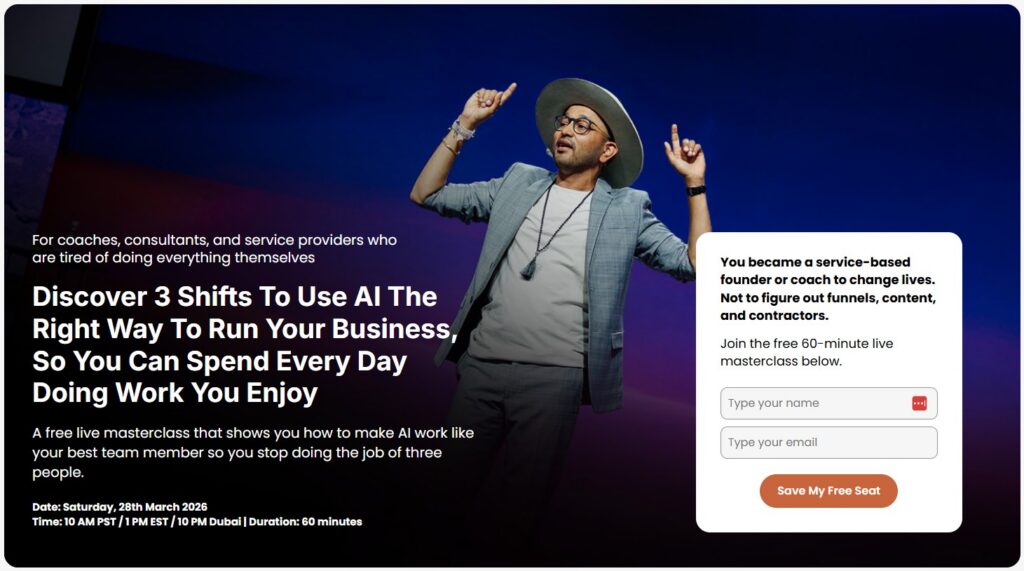
We go deep on all of this inside Greater Inside Founders, our flagship program for coaches ready to build from the inside out. Join the free webinar on March 28th and I’ll show you exactly how to get inside the room.
Your action steps
- Name your market as specifically as you can right now. Write one sentence that describes exactly who you serve and what they feel before they find you.
- Write down your exit criteria for the next six weeks. A number of clients, a revenue target, a number of conversations you need to have.
- List twenty to forty warm contacts and send your first message this week. Not next week. This week.
- Commit to presenting your offer live on a call before you finish building anything else. The conversation is the product right now.
- At the end of six weeks, measure. Not just revenue. Conversations, lessons, assumptions you tested. Then decide.
Let’s build it together
If this landed for you, the next step is to come build it with us in real time.
On the 28th of March, I am hosting a live webinar specifically for coaches and service founders who want to know exactly where AI fits inside a sprint like this.
Because the fastest way to compress your six weeks even further is to stop doing manually what a tool can do in minutes.
First drafts. Follow-up emails. Offer documents. Summarising your calls.
We will walk through exactly which tasks in a service business AI handles well, which tools are worth your time right now, and how to set something simple up without adding more complexity to manage.
Seats are limited. This will not be recorded.
How Did We Do?
If this gave you a perspective you haven’t heard before, share your thoughts in the comments below. I read every comment — your feedback helps me create content that truly moves you forward.
Love. Ajit