
A million dollars feels huge when you see it as one big number. It feels far away, like something you’ll reach only when you’re more confident or more successful.
So you push it into the future.
But when you break that number into days, something shifts.
It stops feeling impossible.
It stops feeling “out there.”
It starts feeling like something you can influence right now.
A million a year is:
$83,333 per month.
$19,230 per week.
$2,739.73 per day.
Now, if you are someone of shaky faith, you might say, “This is a large number.”
I get it, let’s make it easier to work with.
How about we aim to make $100,000 in the first year?
That’s $8,333 per month.
$1,923 per week.
$273 per day.
When you see it this way, the goal becomes real.
It becomes something you can touch.
Something you can work toward with simple, daily actions.

How One Simple Framework Built Danielle LaPorte’s 7-Figure Empire
If you haven’t heard of Danielle LaPorte, here’s the short version: she’s a writer, speaker, and entrepreneur who built a global brand around one simple idea, helping people design their lives around how they want to feel.

But before the books, before the sold-out stages, before the worldwide community of coaches, Danielle was just a woman trying to make ends meet while sharing her truth.
She was making a few thousand dollars a month from:
- Coaching clients
- Small workshops
- Speaking gigs that paid just enough to keep her going
Nothing fancy. Nothing viral. Just daily income from people who trusted her voice.
Then one question reframed everything.
Instead of asking people what they wanted to achieve, she asked: how do you want to feel?
That question became The Desire Map.
At first, it was just a workshop. A room. A handful of people. Some revenue that kept her going.
But she didn’t treat it like a one-off event. She treated it like intellectual property.
She turned it into:
- A repeatable workshop
- A book
- A set of tools
- A teachable method
Now the math has changed.
Instead of asking, “How many hours can I work this week?”
She asked, “How many people can this system serve without me being in every room?”
Then came the move that pushed her business into seven-figure territory:
She certified other people to teach her method.
Facilitators are paid to be trained. Paid more to stay certified. Paid more for updated materials.
One workshop became a worldwide distribution network.
No single day looked like a million dollars.
Most days were small wins that added up over time: a few hundred dollars from a coaching session, a few thousand from a workshop, or a larger payment from a training or cohort.
The money added up over time and built something much bigger.
Her first million did not come because she worked harder.
It came because she stopped selling individual sessions and started selling a system that could multiply without her.
She crossed into seven figures not by adding more hours but by adding leverage.
The real takeaway for you is this:
Your first $100K does not require a huge audience.
It requires a clear offer and consistent daily movement.
Your first million does not require exhaustion.
It requires a method that scales beyond your time.
The money you want is not hiding in the future.
It is hiding in the structure you build now.

Build Income That Isn’t Held Hostage by Your Time
If your income rises only when you work more hours, you will always feel like you are running out of time.
Your calendar becomes the limit. You wake up knowing the only way to grow is to push harder, stretch longer, and give up more of your life.
That is not the road to a million.
That is the road to burnout.
To grow in a healthy way, your income needs to rise even when your hours do not.
This one shift changes everything. It turns your business from a treadmill into a system that supports you instead of draining you.
There are three ways to do this.
1. Productize yourself
Your experience has value, but most people can only deliver it through one-on-one work.
Every client takes more time.
Productizing yourself turns what you know into something people can buy without needing you every single time.
It could be a program, playbook, template, or guided process. You remove repetition. You keep the value. You reclaim your time.
2. Package outcomes, not hours
Clients are not buying your time. They are buying the result your time creates.
When you package an outcome, everything becomes simpler.
Clients know what they are getting. You know what to deliver. You stop getting stuck in conversations about how many calls or how many revisions.
You start talking about the transformation. This makes your work more valuable and removes the limits on what you can charge.
3. Sell results, not effort
No one hires you for how hard you work. They hire you for what your work achieves.
When you structure your offer around results, you gain freedom.
You can use tools, systems, templates, and automation. You can deliver the outcome in the most efficient way possible and serve more people without working longer hours.
When you sell outcomes, effort is no longer the currency. Results become the currency.
This frees your time, and free time creates space for creativity.
Creativity builds leverage. Leverage collapses timeframes.
When you stop trading hours for dollars, your income becomes something you shape, not something you chase.
This is how you reach a million without losing your life in the process.

Shorter timeframes create better focus
Long timelines feel safe, but they secretly fuel procrastination.
When you think you have plenty of time, one delayed day becomes a delayed week, then a delayed month. Not because you’re lazy, but because the timeline is too wide.
Short timeframes sharpen your mind.
You focus on the few things that matter instead of drowning in endless planning.
You stop hiding behind research and start taking action.
And when you compress time, two things happen fast:
- You learn the truth sooner.
Short cycles reveal what works and what doesn’t. You quickly see which message lands, which tasks matter, and which ones are just noise. - You grow faster.
Fast feedback makes you more inventive. You adjust, refine, and experiment instead of staying stuck in preparation.
Short timeframes don’t create pressure.
They create precision.
And precision is what gets you to a million dollars faster and with far more clarity.
No Zero Days and Daily Revenue Activities (DRAs)
If you want faster results, you don’t need huge actions.
You need small, important actions every single day. That’s what No Zero Days and DRAs create: consistency, clarity, and momentum.
No Zero Days means you never end a day with zero movement toward your goal.
One message. One post. One follow-up. One improvement.
Tiny steps keep your identity locked in: I am someone who moves forward every day.

DRAs are Daily Revenue Activities. They don’t guarantee money today, but they increase the chances of money soon.
A DRA moves someone closer to becoming a paying client.
DRAs are not busywork. Not fixing your website, polishing graphics, planning content, or researching. Those feel productive but don’t create income.
Examples of DRAs
- Starting or replying to conversations
- Following up with warm leads
- Sending offers or invitations
- Posting content with a clear CTA
- Sharing wins or transformations
- Improving your offer clarity
Why they matter
DRAs create opportunities, build relationships, keep you visible, and prevent dry months. They give you a steady pipeline and steady momentum.
When you combine No Zero Days + DRAs, everything accelerates:
- You build momentum through tiny consistent actions
- You eliminate procrastination
- You learn faster and adjust faster
- You reduce overthinking
- You shorten the gap between idea and execution
- You shorten the gap between interest and payment
This is how you collapse timeframes.
Not by working harder.
By moving forward every single day in the direction that creates revenue.

Design an Environment That Makes Success Automatic
Most people think success depends on discipline, but discipline is unreliable. It rises and falls with sleep, mood, stress, and even the weather.
Your environment, however, is steady. When designed well, it shapes your behavior automatically. Starting work feels easier, routines flow naturally, and you move forward without fighting yourself.
You can design your environment in three layers: physical, digital, and social.
- Physical environment
Your workspace affects your focus more than you realize. A cluttered desk or uncomfortable chair slows you down. A clean, simple space encourages action.- Keep only tools related to your Most Important Work on your desk.
- Store supplies in consistent spots.
- Use good lighting and keep water nearby.
- Digital environment
Every app, notification, and open tab competes for your attention. A clean digital space helps you stay in deep work longer.- Turn off non-essential notifications.
- Hide or delete distracting apps.
- Use separate browser profiles for work and personal tasks.
- Check email only at set times.
- Social environment
The people around you shape what you consider normal. A supportive social circle accelerates growth; a draining one slows you down.- Spend time with people who push you to think bigger.
- Limit time with those who create drama or doubt.
- Join communities where progress is normal.
Environment shapes behavior, and behavior shapes results. When your environment works for you, momentum becomes the default, and winning becomes easier without relying on perfect discipline.

Your Most Important Work (MIW) Focus for the First Year
Your first year is about building the engine of your business, not perfecting every detail.
Most founders jump around and lose momentum.
A clear focus rhythm solves this. Here’s how to structure your MIW through the year.
Weeks 1 to 4: Product Market Fit
- Understand your people better than they understand themselves.
- Talk to 10 to 20 people weekly. Listen for their struggles, desires, patterns, and exact words.
- This stage is not about selling. It’s about gathering the insights that shape your offer and your marketing.
Weeks 5 to 8: Product
- Turn your insights into a simple, outcome-driven offer.
- Create a minimum viable version with a clear promise and a clear path.
- Price based on value, not hours.
- Work with a few early clients and collect proof.
Months 3 to 6: Marketing
- This is your visibility phase.
- Choose one platform and master it.
- Use the language your audience shared.
- Create content that speaks to the problem and test what actually converts.
- Keep it simple. One mechanism at a time.
Months 7 to 8: Product Again
- With clients and revenue coming in, refine your delivery.
- Simplify heavy steps, improve retention, and reduce the cost to serve.
- Your goal is consistent, reliable results without increasing your workload.
- A stronger product makes your marketing stronger.
Months 9 to 12: Balanced MIW
- Now the business feels real.
- Split your focus between improving the product and improving the marketing.
- Better marketing brings better clients.
- Better delivery creates stronger proof.
- Stronger proof fuels better marketing.
Why this rhythm works
Business grows in stages, and each stage prepares the next.
Follow this sequence and you stop guessing, stop overbuilding, and stop wasting effort.
You grow in a straight, steady, predictable line.
Your Action Steps
- Focus on Your Most Important Work
Pick the one task that moves your business forward the most. This is your growth engine. Nothing else matters until it is done. - Protect Your Time
Schedule everything else, including emails, admin, and team check-ins, around your Most Important Work. Keep growth tasks first so reactive work does not take over your day. - Design Your Environment for Success
Set up your physical, digital, and social spaces so they naturally support focus and productivity. Examples:- Keep your desk clear of unrelated items, have only the tools you use daily within reach, and ensure good lighting and a comfortable chair.
- Turn off non-essential notifications, hide distracting apps, and keep only one or two browser tabs open at a time.
- Place reminders, planners, or your Most Important Work in visible spots to prompt action automatically.
- Make the tools, information, and support you need easy to access so starting work requires minimal effort
- Spend time with people who push you to take action, reduce contact with energy-draining individuals, and join communities or masterminds where progress is normal.
Let’s build it together
This December, I’m running the From Chaos to Million Challenge.
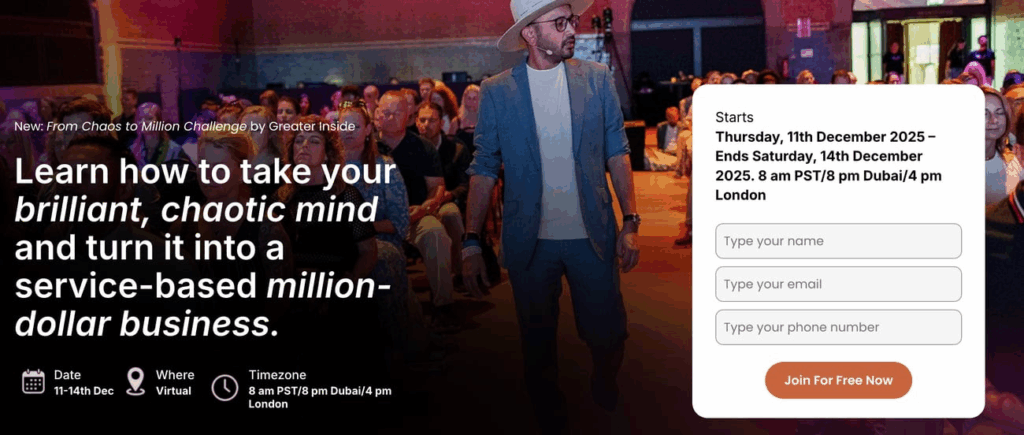
If you want to set a clear vision, create priorities that cut through confusion, draft your first product, stack up offers for maximum impact, and build a marketing plan that generates predictable income, come join me for this three-day challenge.
It runs from Thursday, 11th December to Saturday, 13th December 2025 (8 am PST / 8 pm Dubai / 4 pm London).
You’ll get live sessions, actionable workbooks, and frameworks to help you take real steps toward your first six-figure business and beyond.
How Did We Do?
If this gave you a perspective you haven’t heard before, share your thoughts in the comments below. I read every comment — your feedback helps me create content that truly moves you forward.
Love. Ajit